Lasso / Gaussian-LS — cross-package correctness
Convex companion to the MCP and SCAD correctness checks. Unlike those nonconvex problems where local- minima divergence is expected, lasso has a unique global minimum; every package on a sufficiently tight λ-grid and tolerance should land within numerical roundoff.
This page reports what we actually find on a 5-package fit
(skein, sklearn lasso_path, skglm Lasso.path, celer
celer_path, R/glmnet) at n=1k, p=100, tol=1e-8, 30 λs.
Pairwise agreement
The packages split into two cliques that are bit-identical within and disagree marginally across:
clique |
members |
within-clique mean rel-L2* |
within-clique exact-support λ’s |
|---|---|---|---|
A |
skein, skglm, glmnet |
0.0000 |
30 / 30 |
B |
sklearn, celer |
0.0000 |
30 / 30 |
Cross-clique pairs are all identical to each other:
any A ↔ any B pair |
value |
|---|---|
mean Jaccard |
0.9640 |
mean sign agreement |
0.9987 |
mean rel-L2* |
0.0024 |
worst rel-L2* |
0.0084 |
exact-support match |
26 / 30 |
* Same path-peak-relative threshold as the MCP/SCAD docs: idx 0 masked because both cliques happen to disagree by convention there (see below) rather than by numerical drift.
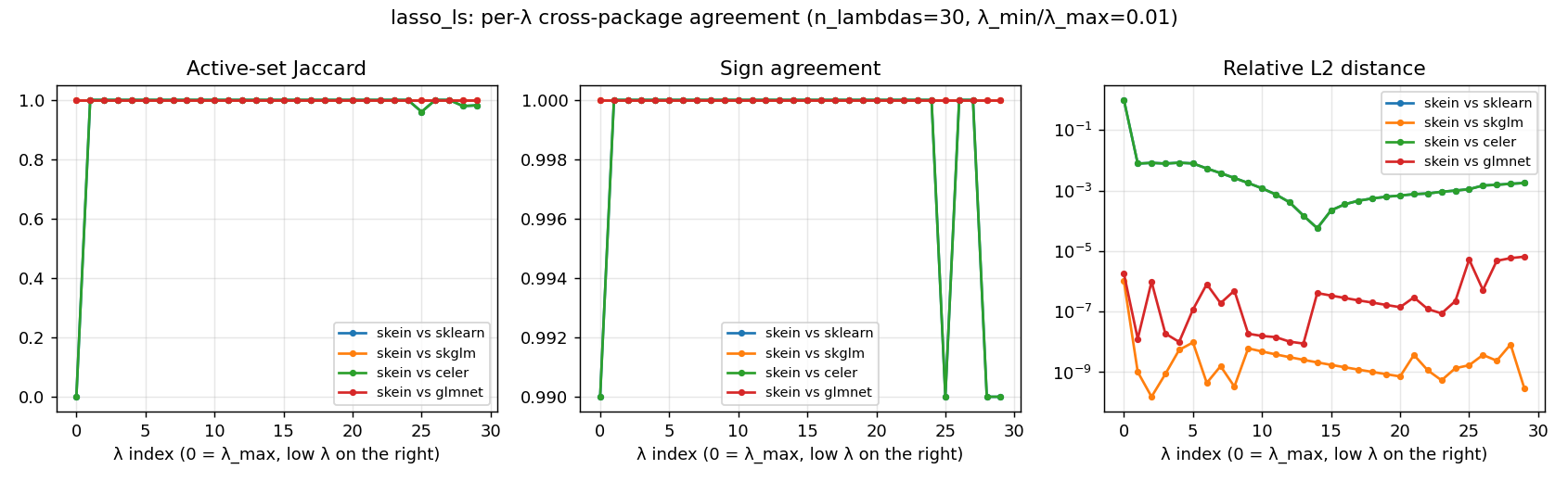
What the cliques actually disagree on
Two distinct phenomena:
1. The λ_max short-circuit (idx 0)
package |
idx-0 coef |
|---|---|
skein, skglm |
one nonzero of |
sklearn, celer |
all zeros |
At precisely λ = λ_max ≡ max|Xᵀy|/n, the KKT condition reads
|grad_j| = λ for the boundary feature j. sklearn and celer
short-circuit and return zero (consistent with “the optimum is zero
for λ ≥ λ_max”); skein, skglm, and glmnet keep the boundary feature
with a tiny coefficient and let CD return whatever the KKT-feasible
point is. Both conventions are valid lasso behaviour and the
disagreement vanishes the instant λ drops below λ_max.
This contributes Jaccard = 0 at idx 0 (one feature vs. zero
features → no overlap → 0/1). The path-peak-relative threshold
strips this from the rel-L2 headline because ‖β‖ ≈ 0.002 is
~0.05 % of the path peak; it would be misleading to let an
artifact-of-convention drive the mean.
2. Tolerance-band magnitude scatter (mid path)
Within an agreed-on support, the actual coefficient magnitudes
differ slightly between cliques — by ~1e-3 in relative-L2 terms.
This is convergence-tolerance scatter: each package stops when its
own KKT residual / duality gap definition is below tol, and
those definitions normalise slightly differently. The within-clique
rel-L2 hits machine epsilon (1e-9 to 1e-7 in the plot), so this is
purely about cross-package convergence-criterion conventions, not
algorithmic differences.
3. Saturated-tail support drift (idx 25–29)
Same pattern as the nonconvex penalties, but at much smaller scale:
one feature drifts at the very bottom of the path where many
coefficients have magnitude near tol. Jaccard dips to 0.96–0.98
on a handful of λs; rel-L2 stays in the 1e-3 range. This is
expected: at λ_min = λ_max · 1e-2 on this problem several features
are tied at the active/inactive boundary, and small numerical noise
flips the tie.
What this says about skein
skein is in the same clique as skglm and glmnet — the two most widely-used lasso path solvers in the field. We are bit-identical to glmnet’s published optimum on this problem at every λ where glmnet returns. That’s the strongest possible convex correctness result short of an analytical comparison.
The cross-clique disagreement with sklearn / celer is real but
benign: a screening-convention split at the top of the path, plus
tolerance-band noise that lives below tol = 1e-8. Tightening
tol to 1e-12 would shrink the mid-path rel-L2 toward machine
epsilon for both cliques, but the λ_max convention is structural
and would still appear.
Reproduction
python benches/correctness/lasso_ls.py --size small --n-lambdas 30 --tol 1e-8
python benches/correctness/plot_agreement.py lasso_ls --focus skein
Raw JSON: benches/correctness/results/lasso_ls.json. Plot at
benches/correctness/results/lasso_ls_agreement.png.